


“Doctor, attend in psychiatry please.”
If you just read that in a nasally, slightly bored British accent, congratulations. You are my people. And if you heard it while frantically trying to navigate a cursor with a D-pad while a man dressed as Elvis vomited in your corridor, then you are specifically my kind of console peasant.
Let's talk about Theme Hospital on the PlayStation.
The Christmas Wild Card
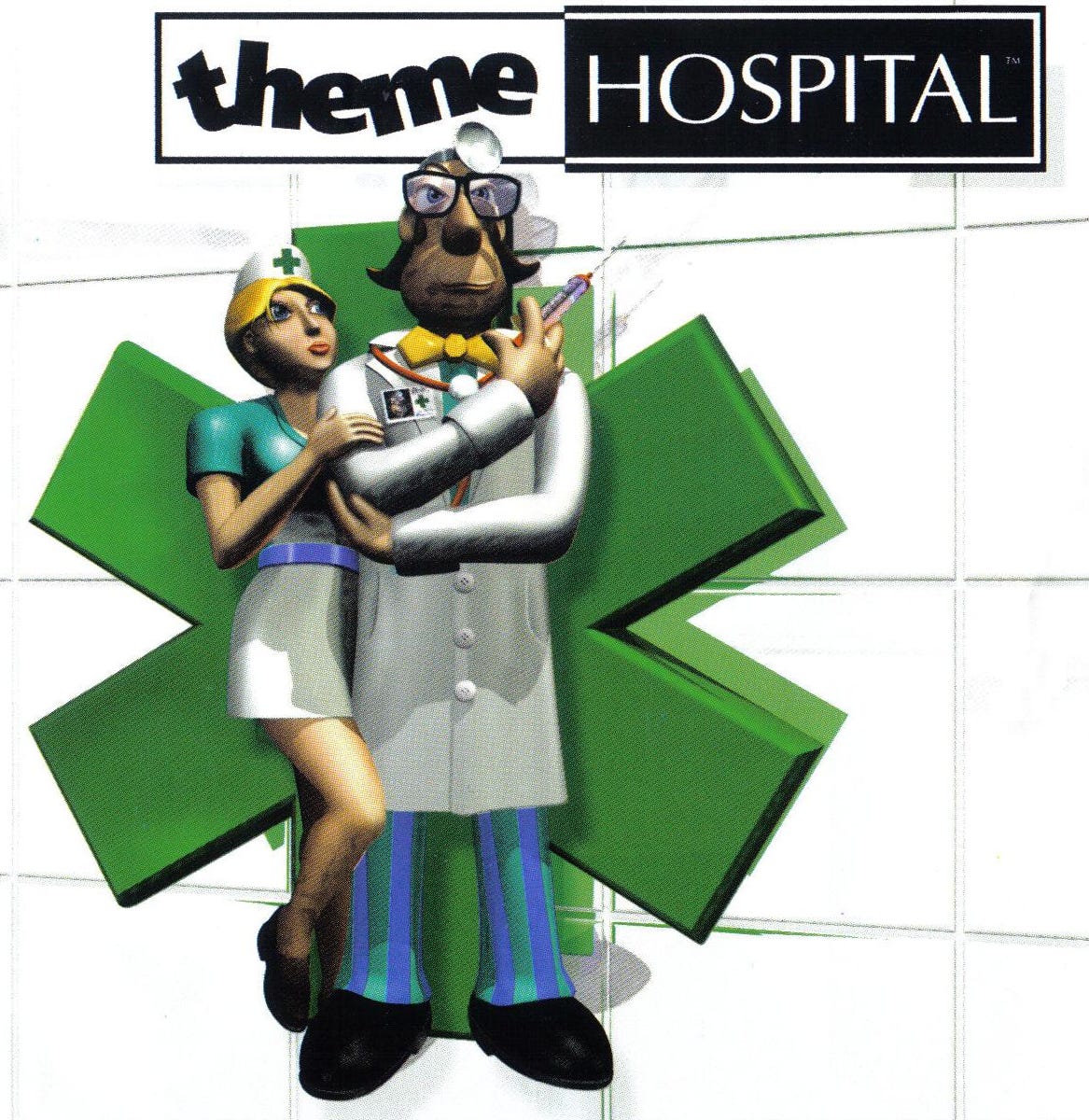
I’ll be honest, I remember being a bit confused unwrapping this one for Christmas.
It wasn't on my list. I hadn't circled it in the catalogue or begged for it for months. It was a total wild card - a "parents in a panic" purchase? Perhaps. But I suspect they were standing in the game aisle on Christmas Eve, saw the friendly cartoon doctors on the cover, and thought, "Well, it looks educational enough."
It was anything but. Between popping patients' inflated heads with giant needles and shooting rats in the waiting room, 'educational' was the last word I'd use to describe it. But I went in with zero expectations and zero prior interest, and ended up completely hooked.
If you’d looked at my shelf back then, Theme Hospital would have looked like an interloper. I was an arcade kid through and through. My personality was built on the drift physics of Ridge Racer, my button-mashing capabilities in Tekken 2, and the chaotic road rage of Road Rash.
I had a type, you see.
Theme Hospital broke all my usual rules. Instead of testing my reflexes, it challenged me to find some sort of order within a chaotic medical setting. But it also offered a weirdly charming and cynical world and, weirder still, became a quiet sanctuary whenever I grew tired of my more typical arcade experiences.
Where’s the Any Key?
For me in the 90s, the “Family PC” wasn’t a gaming rig but more a sacred beige obelisk located in the home office, strictly guarded by my dad. It was for spreadsheets, Encarta 95, and occasionally typing up homework.
Installing anything felt like a dangerous game of 'don't break the computer,' mostly because I tended to ignore instructions in my rush to play.
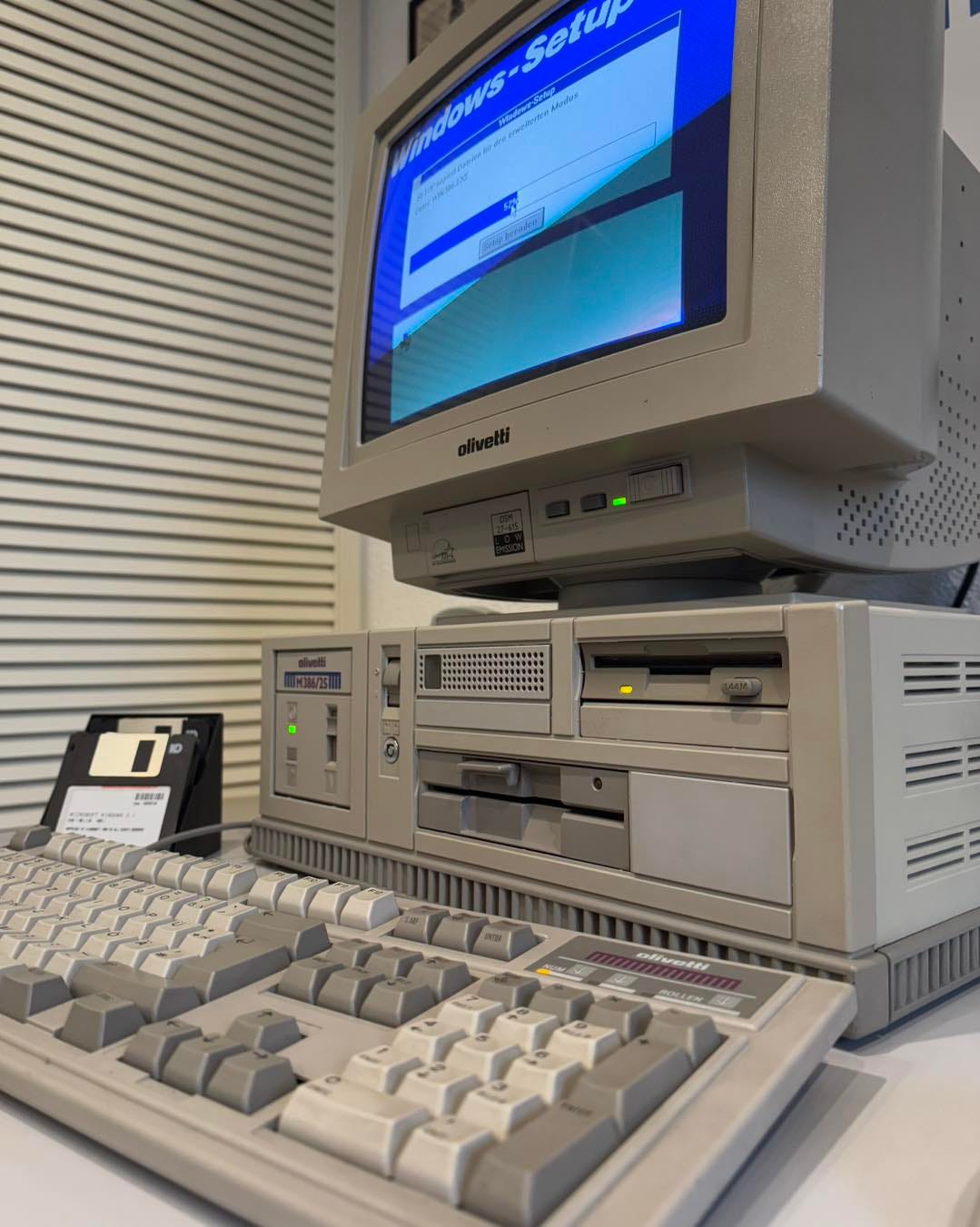
I was twelve and convinced I knew exactly what I was doing, even when I didn’t. This gung-ho attitude made my dad incredibly uneasy. He knew my technical ambition was often more dangerous than the software itself.
The PlayStation, by comparison, was mine. It was the cheaper, scrappier entry point into the world of management/strategy gaming. It was accessible. I popped the lid, snapped in the black disc, and I was playing.
No stressed out dad looking over his shoulder. No potential hijinks because I deleted Win32.sys by accident.
The PlayStation Experience: A Beautiful Mess
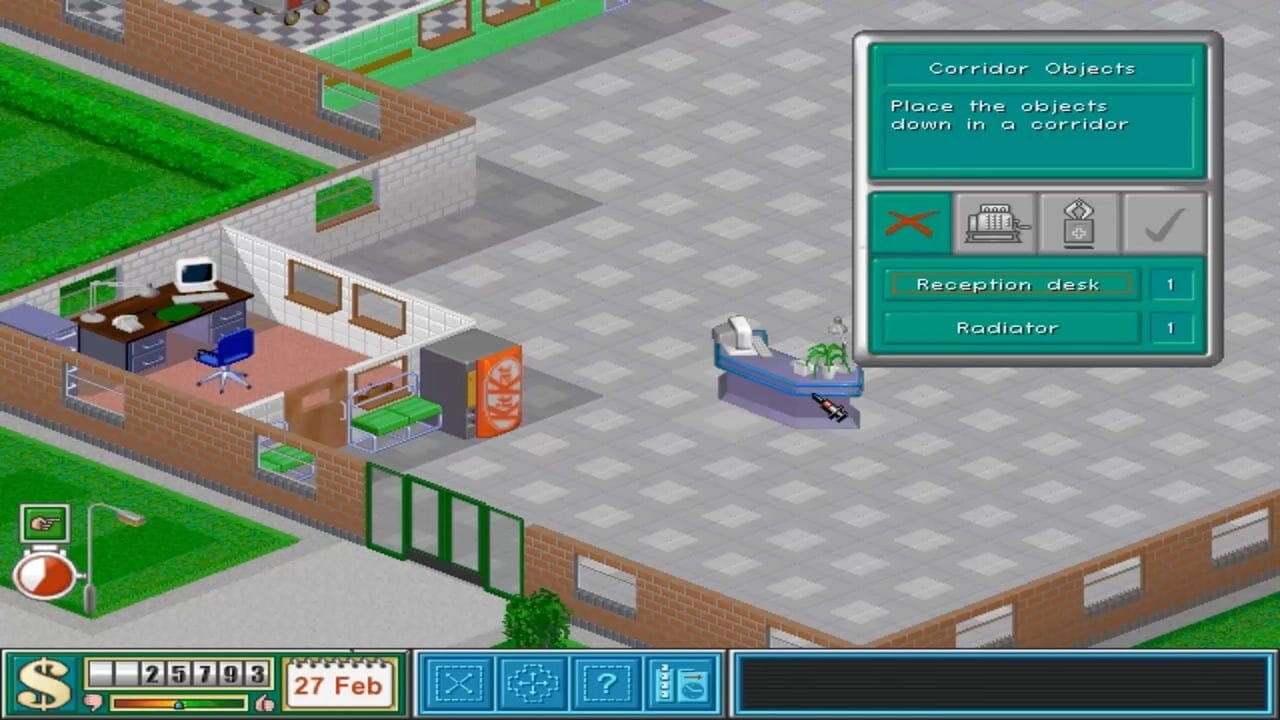
Developed by Krisalis Software and released by Electronic Arts in 1998, playing Theme Hospital on the PlayStation was, admittedly, a lesson in patience. The team had the unenviable task of translating a mouse-heavy, and UI heavy, PC game to a controller, and they had to make some serious compromises.
First, let's talk about graphics, specifically, the resolution.
The PlayStation couldn’t handle the crisp SVGA graphics of the PC, so everything looked a bit like it had been smeared with Vaseline. The patients (originally a diverse bunch on PC) were apparently reduced to generic ‘clones’ to save memory.
Regardless, Absolute PlayStation praised the charming character sprites but criticised the muddy resolution and user interface that ‘felt like a dusty relic from the 16-bit era’.
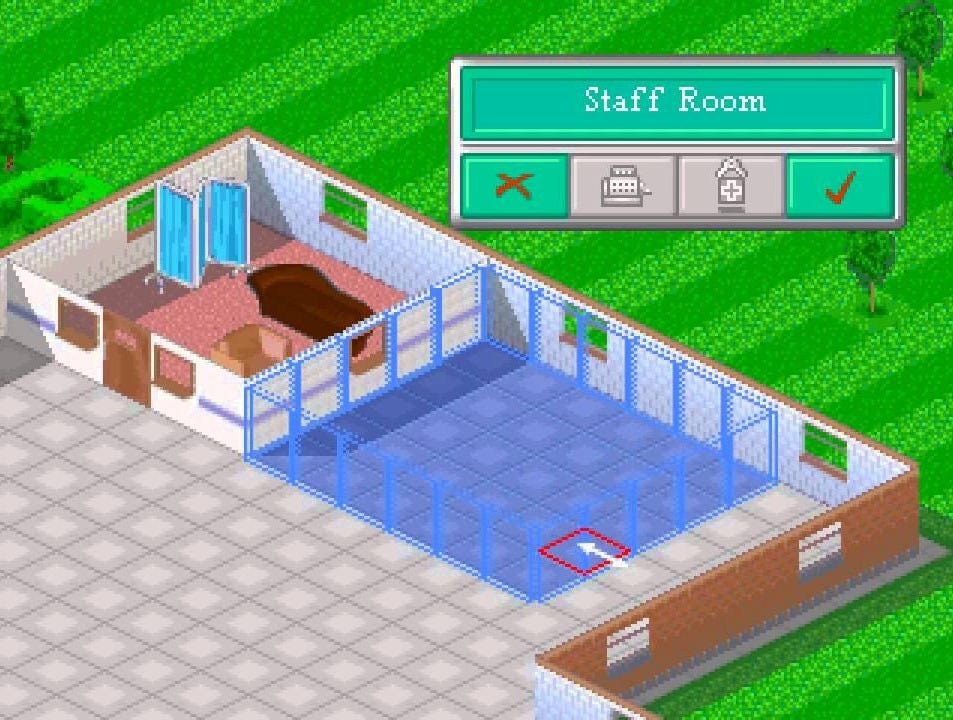
Yes, sacrifices needed to be made, but it was a relatively small price to pay. The logic was simple: if you had a PC, that was the definitive way to play. But if you had a PlayStation, you simply rolled up your sleeves and did your best to cure Slack Tongue and Alien DNA with the tools you had.
Sadly, the music took the biggest hit. The original PC tunes are so catchy that people still hum them today, but you wouldn't know it from this version.
So what was left on the PlayStation version? A sterile silence broken only by the ambient sounds of sickness. We were left with a loop of coughing, retching, and that iconic tannoy, which (without the music to mask it) could veer from immersive to repetitive after a few hours.
It was never a problem for me, though I do wonder why the music wasn’t included.
But the real challenge was the controller.
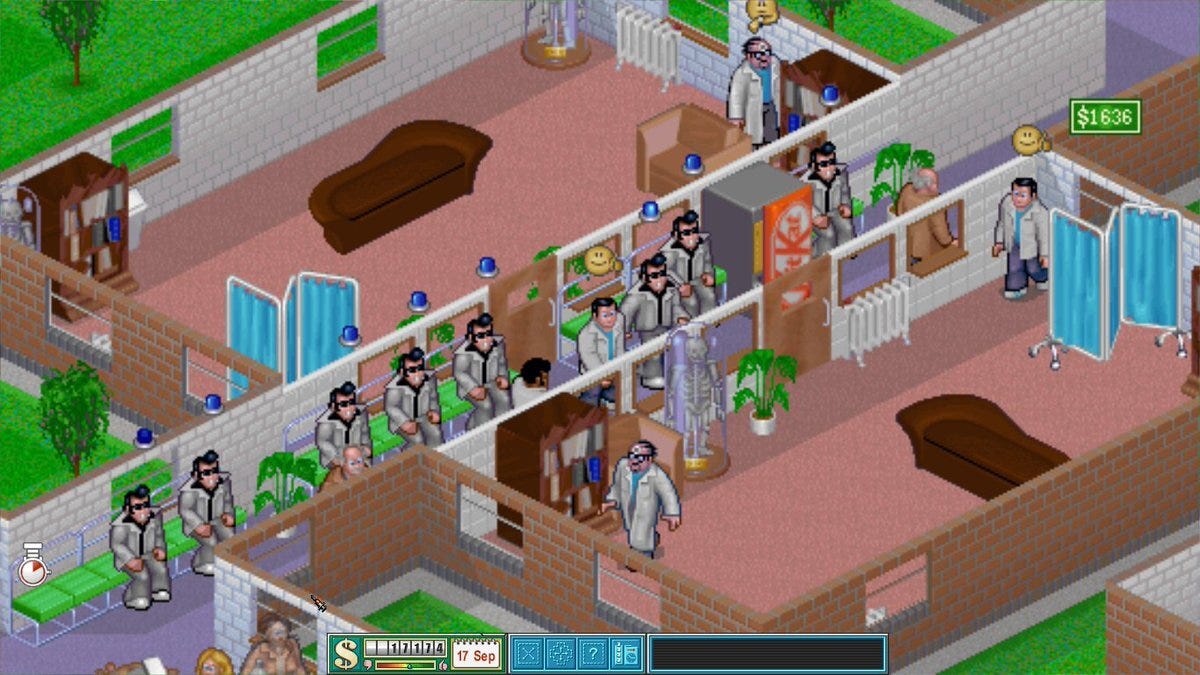
Imagine, if you will, trying to be a hospital administrator using a claw machine. To build a room, you couldn't just click and drag. You had to navigate menus, select a blueprint, and then painstakingly tap-tap-tap the D-pad to lay out the walls.
That said, the game’s inherent grid system actually adapted surprisingly well to the PlayStation pad, turning those digital taps into precise, tile-by-tile placement. Despite the "clunk," the genius of the game shone through.
The Dopamine Loop
So strip away the fuzzy textures and the muted audio, and you are left with a gameplay loop that is as addictive today as it was in 1998. The progression is masterful. We’re talking chefs kiss perfect here. You start with a humble empty lot and a generic blueprint.
You lay out the basics - assigning the doors and windows for a GP’s Office, placing a Psychiatric ward in the corner, and dotting the corridors with benches and fire extinguishers (which you will need).
But soon, the chaos ramps up in the best possible way.
The “Dark” Management: You had to manage staff exhaustion, dragging tired doctors out of rooms with your cursor claw to force them into the Staff Room. You had to balance the books, sometimes taking out loans just to buy a new operating table. You could even tweak hospital policy to force patients to pay for unnecessary diagnoses - capitalism at its finest.
The Diseases: The charm was in the ailments. You were treating King Complex (where patients think they are Elvis), Alien DNA (where they morph into grey aliens), or the classic Bloaty Head. Watching a patient get cured (or watching a machine explode because you forgot to hire a handyman) was a constant visual treat.
The Emergencies: Then there were the epidemics. Suddenly, a contagion spreads, and you have a choice: pay the fine and fess up, or try to “cover it up” by curing everyone before the Health Inspector arrives. It was a gamble that usually ended with a damaged reputation and a ghost haunting your hallway.
There is a timeless satisfaction in researching a new cure, hearing that distinct ping of the research lab, and finally building the machine that saves the day. It’s a game of spinning plates, and even on the PlayStation, keeping those plates from crashing feels fantastic.
There was just something incredibly cozy about sitting on the floor, staring up at a CRT TV, and managing the absolute chaos of a busy ER. The PlayStation version had a charm all its own. The “board game” cutscenes between levels (which replaced the static screens of the PC version) felt like a reward for surviving the previous level’s epidemic.
Ultimately, this clunky PlayStation port laid the unshakeable groundwork for its spiritual successor, Two Point Hospital. While the modern incarnation cleans up the visuals and perhaps loses some of that specific, gritty Bullfrog charm in the process, it certainly doesn't lose all of it.
The DNA is undeniable.
Theme Hospital walked so Two Point could run, proving that the chaotic joy of hospital management could work on a console, and ensuring the legacy of curing 'Bloaty Heads' would live on for a whole new generation.
Note: I never reached 'Alien DNA' on the PS1, so I can't confirm if it exists there or not.
Theme hospital was a classic. My brother and I would repeat the tannoy announcements to each other way after we'd finished playing the game for the day! We played it on PC on our Packard Bell running Windows 95 😎
You've reminded me about a classic. I bought this game for the PC as a present to my friend - he was also probably wondering why I chose this one, it didn't seem in line with either of our typical styles. Yet, like Theme Park, we both fell in love playing it together. The sense of humour was the best part of it.