


Remember when video games came wrapped in genuine mystery? When the only glimpse you got of an upcoming title was through the glossy pages of GamePro or Electronic Gaming Monthly, and those precious screenshots felt like archaeological artifacts from another world?
In 1996, one particular set of images would intrigue Resident Evil fans for years.
Capcom had been teasing their upcoming sequel, and early promotional materials showed something unexpected. There she was, blonde ponytail swishing as she ran through zombie-infested corridors.
But this wasn't Claire Redfield. The magazines called her Elza Walker, and she was going to be one of Resident Evil 2's protagonists.
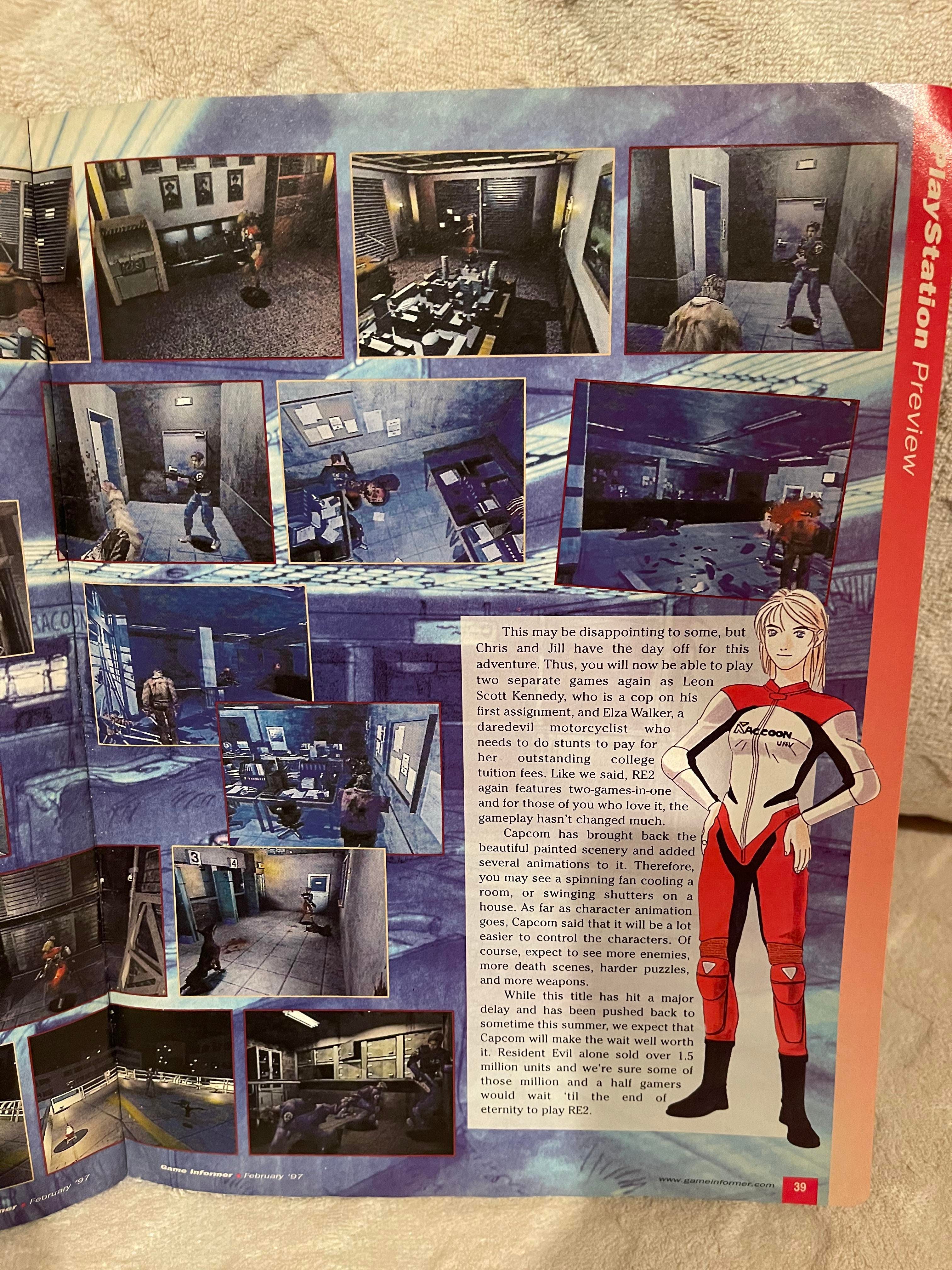
Elza looked different from the final game's heroes.
She wore a distinctive leather jacket and had an almost punk rock aesthetic that stood apart from the clean-cut Leon Kennedy and girl-next-door Claire.
The screenshots showed her wielding weapons, exploring the familiar RPD station, doing everything you'd expect from a Resident Evil protagonist.
But then something strange happened.
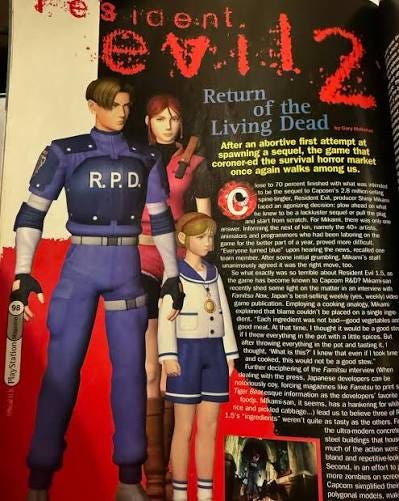
As Resident Evil 2's release date approached, Elza Walker simply vanished. New screenshots started appearing with Claire Redfield instead. The magazines never explained what happened to the mysterious blonde woman.
She just disappeared from the promotional materials like she'd never existed.
This was 1998. The internet existed, but barely anyone had it, and even fewer used it to discuss video games. Most households were still on dial-up, if they were online at all.
Gaming websites were primitive affairs with basic text and maybe a few low-resolution images that took forever to load. There was no Wikipedia to quickly check development history, no Reddit threads dissecting every screenshot, no gaming journalists with instant access to developers via Twitter.
The gaming community existed in isolated pockets. You had your local friends, maybe a bulletin board system if you were lucky, and that was about it. Information traveled slowly, through magazine letters sections and word of mouth.
A rumor that started in California might take months to reach players in other states, morphing and growing along the way.
But the Resident Evil community never forgot her. Forum threads would pop up asking "What happened to that blonde girl from the early screenshots?"
Players combed through every corner of the final game, convinced that Elza must be hidden somewhere. Maybe she was an unlockable character.
Maybe there was a secret cutscene. Maybe you had to beat the game with perfect scores to access her storyline.
The mystery grew larger in the absence of information. Some players swore they'd seen additional Elza Walker screenshots that others couldn't verify. Others claimed she appeared in early gameplay footage at trade shows.
Without widespread internet access to fact-check or preserve every piece of promotional material, these claims took on an almost mythical quality.
The Golden Age of Gaming Mysteries
Around the same time, players were chasing rumors about hidden characters in Street Fighter, secret levels in Super Mario Bros., and elaborate codes to unlock everything from nude Lara Croft to playable Sheng Long.
Each mystery lived in its own bubble, sustained by limited information and endless speculation.
The Mortal Kombat series thrived on this environment. Players spent years trying to perform impossible fatalities described in playground rumors. "Animalities" existed as pure speculation long before they became real.
The infamous "Ermac" glitch that occasionally displayed the name on arcade cabinets spawned an entire fictional character that fans insisted was hidden somewhere in the game.
Even more elaborate was the legend of EarthBound's Giygas having hidden meaning in its final boss sequence. Players analyzed every pixel of the disturbing imagery, convinced there were faces or messages hidden in the swirling patterns.
Without frame-by-frame analysis tools or easy access to the game's data, these theories could flourish unchallenged for years.
The PlayStation era amplified this phenomenon.
The console's CD format meant games could have enormous amounts of content, and loading screens created natural mysteries. What was happening during those long loads? Were there hidden areas the game was accessing? The black screens between areas felt pregnant with possibility.
Years Gone By
The mystery of Elza Walker became one of those gaming urban legends passed between friends. "Did you know Resident Evil 2 originally had a different female character?" It was the kind of secret knowledge that made you feel connected to gaming's hidden history.
The truth, when it finally emerged through developer interviews and behind-the-scenes documentaries years later, was both simpler and more complex than anyone imagined.
Elza Walker had indeed been Resident Evil 2's original female protagonist. She was a college student, a motorcycle enthusiast, someone with a completely different personality and backstory from Claire Redfield.
But Capcom had scrapped her late in development.
What fans would later learn was that Elza Walker belonged to what's now known as "Resident Evil 1.5" - an entire version of Resident Evil 2 that was nearly complete before being thrown out entirely.
The team decided it wasn't scary enough and started over from scratch, creating the version we know today. Claire Redfield was designed as Elza's replacement, sharing some visual elements but with a completely different character concept.
Resident Evil 1.5 was a different game entirely. Different enemies, different story beats, even different areas of the police station.
Those magazine screenshots weren't just showing an alternate protagonist, they were glimpses into a completely parallel version of Resident Evil 2 that would never see the light of day.
Elza Walker hadn't been hidden in the game. She'd been erased from it.
I’m not sure this kind of mystery could survive today. Development footage gets leaked constantly. Data miners dig through game files before release day.
Every piece of concept art eventually surfaces on social media. The gap between "what we were shown" and "what we got" gets filled in real time by an army of internet detectives.
But back then, in that beautiful pre-broadband gaming era, mysteries could live and breathe. They could grow in the spaces between magazine issues, sustained by playground rumors and primitive forum speculation.
The absence of information wasn't frustrating, it was magical. And as much as I've tried to articulate that here, I don't think I've done it justice.
The limited internet access of the late 90s created perfect conditions for gaming mythology. Even when bulletin board systems and early gaming forums existed, they reached tiny audiences.
A rumor debunked on one BBS might continue thriving in another community for months. Information traveled at the speed of magazine publication cycles, not fiber optic cables.
Compare this to today's gaming landscape, where a single dataminer can solve every mystery within hours of a game's release.
When Resident Evil 3 was remade in 2020, players had completely mapped its content, found every Easter egg, and documented every cut feature before most people had finished their first playthrough.
The sense of collective discovery, of slowly piecing together secrets over months and years, has been compressed into a few intense days of internet collaboration.
But there was something beautiful about that slow drip of information. Gaming journalism in the 90s was highly curated, almost ritualistic. You had to wait, sometimes months on end, for the next magazine to drop.
Each issue felt like an event. The excitement of seeing that fresh GamePro or EGM on the newsstand, the comfort of knowing you had an evening of discovery ahead.
Those magazines were hyperbolic, sometimes over the top and full of absolutes. Every game was either "REVOLUTIONARY!" or "TOTALLY RADICAL!" But they were also hugely accessible.
The writers spoke directly to you, no pretense, no academic jargon. They made you feel like gaming mattered, like you were part of something important.
Many of us read and write now because we read those magazines then. They taught us that passion could translate into words, that excitement was worth sharing.
Picture those rainy afternoons when you'd grab your latest magazine and settle in somewhere cozy. The street lights outside would flicker on as you turned each page, momentarily illuminating screenshots of worlds you'd never seen.
Each image was precious because it might be months before you saw anything else from that game. We became detectives, piecing together narratives from scattered screenshots and cryptic developer quotes.
The pre-release period wasn't about immediate gratification. It was about anticipation building over time. That blurry screenshot of Elza Walker was just a marketing image, sure, but it was a puzzle piece in a larger mystery we were all too happy to help solve too.
We'd study every pixel, analyze every background detail, theorize about what it all meant.
Gaming magazines understood this rhythm. They'd tease you with a single screenshot one month, maybe add a brief developer quote the next, then finally deliver a full preview closer to release.
It was a cheeky exchange between the industry and its audience, a shared understanding that the journey was as important as the destination.
Elza Walker represents something we've lost in gaming culture. Not just the thrill of genuine secrets, but the romance of the unknown. Those grainy magazine screenshots weren't just promotional materials.
They were glimpses into parallel gaming universes, worlds we might have inhabited if development had gone differently.
Sometimes the mystery was better than the truth. Sometimes the girl who never made it into the final game was more interesting than the one who did.
This was great to read, and I'm absolutely with you on how there is very little mystery any more. I remember reading magazines like you and reading all the details, looking at all the screenshots, waiting for the next monthly issue. Then there would be bumper issues across the year - E3, Christmas - where lots more news would come, but like you said at a slower pace.
The missing character from RE2 reminds me of what I wrote about with Sonic the Hedgehog 2. That game had tons of content cut from it, but because it was all rushed during development there would be marketing materials to show things that never happened in the end. But that mystery or feeling of what could have been is sustained for years after, where people really will comb, hunt and document these things, especially as bits and pieces of the content or code would usually still be present in the final game. I really admire that, it's what keeps some games alive.
Great post! Never heard of Elza before this post, but I am with you, I miss when gaming had mystery.