Ghost in the Shell
A techno-fueled joyride in a spider tank

Developer: Exact
Publisher: Sony
Release: JP, US 1997. EU 1998.
Platform(s): PlayStation
I still remember the first time I saw Ghost in the Shell.
It wasn’t planned. It wasn’t sanctioned. It definitely wasn’t something my parents would’ve approved of. One moment I was bouncing between Dexter’s Laboratory and the oiled, shouting fever dream that was UK Gladiators.
The next, I had wandered into something that felt illegal to comprehend.
At the bottom of the stairs sat a battered VHS rental under the warm glow of a Tiffany lamp. I don’t know who left it there. I don’t know why it existed. I do know that I shoved it straight into my chunky VHS player like I was disposing of evidence.
The tracking lines were aggressive. The static was constant. It felt cursed. Perfect.
I dimmed the lights, put on my absurdly oversized headphones, and watched the studio logos crawl across the screen while the audio garbled like it was being broadcast from the future via a microwave.
Watching it felt like someone had reached into my skull and flicked a switch I didn’t know existed. Total system override. Brain reboot. New firmware installed without consent. From the first frame, I was gone. I slipped into another world, my own existing only in my peripherals.
It was like a philosophy lecture wrapped in thermoptic camouflage and delivered at sniper rifle velocity. Heavy ideas. Big questions. Cool guns. The dream combo. It shoved me headfirst into futurism and techno, then locked the door behind me.

I wasn’t alone, either. The film rewired cinematic science fiction. It asked whether identity lives in memory or if we’re just data rattling around in a meat shell. It helped clear a path for The Matrix. It made cyberpunk lunch-table discussion material at school, which went about as well as you’d expect.
And yet, despite my obsession with the film, the PlayStation game somehow passed me by.
I remember seeing it on the shelf at my local game shop weeks after launch. Then months. It just sat there, quietly existing. I assumed it was another cheap tie-in. A rushed cash grab. One of those games that smelled faintly of disappointment and rental regret.
I watched the price fall. £45. £30. £20. At that point, resistance felt silly. Buying that jewel case was one of the smartest gaming decisions I ever made. It didn’t just give me a great weekend. It locked in a lifelong love of cyberpunk and techno that still hasn’t let go.
Missions: 12 story missions
Cutscenes: 17 unlockable anime scenes by Production I.G
Training: 6 stages that teach movement and combat
Endings: Short mission-end animations based on performance
33.8 MHz MIPS R3051 CPU
Alright, kid. Here’s the deal. You’ve got a Fuchikoma. Try not to scratch it.
Your job is to hunt down the Human Liberation Front as they redecorate the city using explosions and poor life choices. Simple setup. No nonsense. And when revenge feels this good, who’s asking for complexity?
The Fuchikoma that features so heavily is a red, spider-like ‘thinking’ tank. It’s fast, agile, and powered by a genuinely cheerful AI. Not one of today’s LLMs that confidently regurgitates strings of text to your face. This thing actually thinks. It jokes. It reacts. It cares.
Have I mentioned that this is the future? Or at least the version of it where you can run upside down across skyscrapers in a mechanical crab with guns.
And it feels incredible. The gameplay is the real star. It felt great in 1997, and it still feels great now as we crawl toward the end of 2025. Every leap between buildings lands clean. Every boost feels deliberate.
Sliding into position while locking onto multiple targets never turns clumsy. The machine does exactly what your hands ask of it, which makes every encounter feel intentional.
Some critics at the time said it was too easy. Too repetitive. Personally, I was more than fine with that. Piloting the Fuchikoma feels so good that I didn’t need the game to punish me for enjoying myself.
What might have been referred to as too repetitive then might be referred to as a satisfying game loop now. To me, they nailed the sensation of movement. The controls are tight and responsive. You can strafe, boost, and jump to absurd heights.
And the wall-climbing is the real trick. You can scuttle up any surface, flip onto the ceiling, and keep firing while the camera behaves like it’s done this before. Few games of that era felt this agile.
Exact, the studio behind the game, were already masters of vertical chaos thanks to Jumping Flash. If you played those games, you’ll recognize the DNA immediately. That joyful sense of movement is everywhere here, just wrapped in metal plating and existential dread.
Eighteen Months of Care
The game spent a year and a half in development under director Kenji Sawaguchi and producer Tetsuji Yamamoto. They took the bouncy madness of a robotic rabbit and grounded it into a heavy spider tank without losing the fun.
I don’t think that’s a particularly easy feat, especially when it doesn’t take much for players to become disorientated when traversing walls and ceilings.
The jump from high-concept anime film to PlayStation disc was handled with surprising respect, too. Masamune Shirow himself wrote and illustrated the story and art design. That involvement matters. It gives the game credibility. It never feels like it’s borrowing the name.
It feels like it belongs.
The plot stays lean and keeps the focus on action, but the real story is the bond between you and the machine. Growth doesn’t come from speeches. It comes from familiarity. By the end, you move as one unit.
Since the Rookie is a blank slate, the Fuchikoma steals the spotlight. It chirps. It reacts. It celebrates your success like a loyal titanium puppy armed with heavy artillery. It’s charming without trying too hard, and it tells a story without drowning you in cutscenes.
Chasing the Look of the Movie
For a 1997 release, this game looks good. It might even be one of the best-looking titles on the PlayStation. No, it’s not Gran Turismo or Metal Gear Solid, but it runs like a glass of cream poured directly onto polished marble.
Using a modified Jumping Flash engine, the game builds a dense (for the PlayStation) cyberpunk city that blurs past in neon streaks as you boost through it. The frame rate holds up. The animations shine.
Then there are the cutscenes.
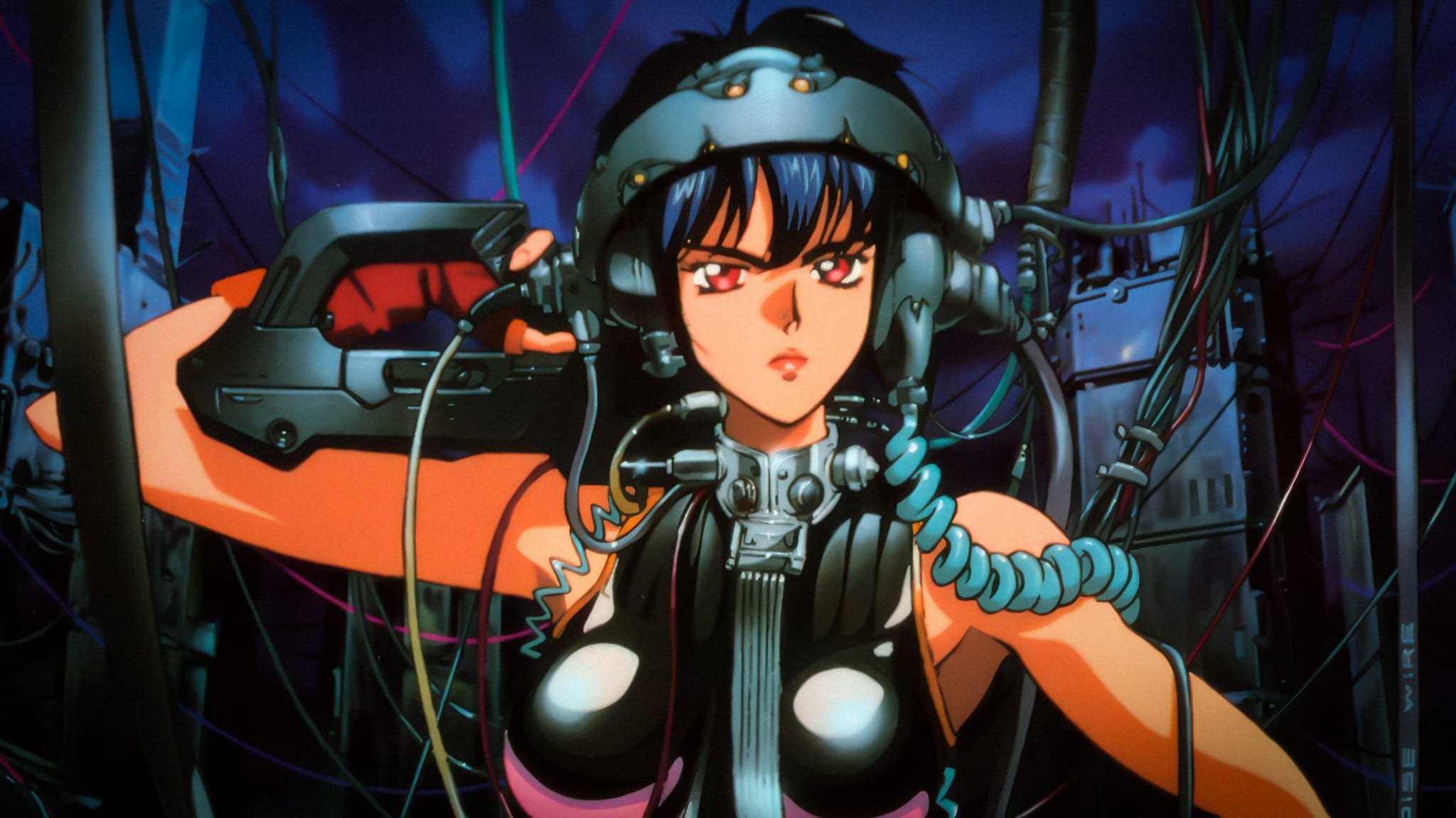
Production I.G handled the anime sequences, and they look fantastic. Some outlets even claimed the opening animation looked better than the film itself. These moments made the game feel expensive. You’d watch a flawless briefing from the Major, then drop straight into the mission without losing momentum.
The soundtrack seals the deal. This is pure 90s techno, and the developers treated it like a headline act. The Japanese release came with a full launch event called Megatech Body Night, featuring artists like Takkyu Ishino, Joey Beltram, and Mijk van Dijk.
Acts I’ve seen myself, thankfully, in my relatively smallfry hometown of Belfast. These musical memories are fading, blurring into one continuous stream of faded consciousness. Thankfully, the music lives on in the form of the OST.
And that musical energy bleeds into every mission. IGN praised the soundtrack for good reason. Tracks from Derrick May and Hardfloor drive the action forward. This game taught me how good techno could be. I still can’t hear similar thumping grooves without picturing spider tanks, explosions and 90s Day-Glo user interfaces.
So, Worth a Play?
How was Ghost in the Shell received? Pretty well, all things considered. It landed around 78 percent on GameRankings. Critics loved the visuals and wall-climbing. GameFan said it lived up to the name. Others weren’t convinced.
The main complaint was difficulty. Unlimited ammo. Regenerating health. Boss fights that look spectacular but boil down to circle-strafing and holding fire. They weren’t wrong. But I took it as a power fantasy, not a stress test.
Even so, the game holds up beautifully. It’s short and sharp. No filler. No drag. Game Informer later backed this up by naming it one of the best anime-based games ever made, calling it the strongest entry in the franchise.
I love this game because it understands something important. Being a spider tank is fun. It doesn’t overthink itself. It looks great, plays smooth, and sounds incredible. It’s late-90s confidence pressed onto a disc.
Maybe Ghost in the Shell was always going to be niche. It never had Sony shouting about it from every billboard or stuffing it into every demo disc. But to anime and cyberpunk fans, it sits in the same place antigrav racing does for Wipeout.
It’s a reference point. A tone-setter. A quiet line in the sand that says, this is what cool looks like. It mattered in ways that didn’t need charts or sales figures to prove it. Even without the marketing muscle, it carried the same cultural weight for the people it was meant for, and that kind of importance tends to age far better than hype.
Thank you to Diniz Games on YouTube for providing the footage used in this article.


Awesome article Chris! I've been meaning to watch the 1995 movie at some point, but always end up forgetting about it. For the past few weeks though, I've kept seeing the PS2 game come up on my social feeds with it looking really cool, but I had no idea that a PS1 game existed! That's super neat, and I've loved the music so far!
Definitely will have to keep my eyes open for this at some point, and this was a good reminder that I finally just need to sit down and watch the movie haha!
Thanks for sharing and writing, awesome work as always!